How to Use Line Weight When Drawing Anime & Manga
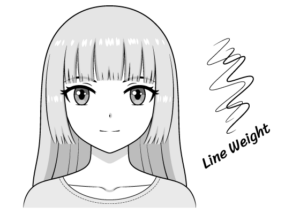
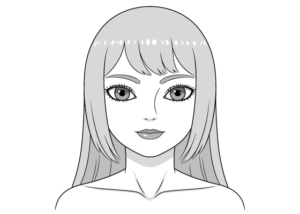
This tutorial explains the importance of line weight when drawing, with a focus on the anime, manga, and comic book styles. It examines several linework variations and other related techniques.
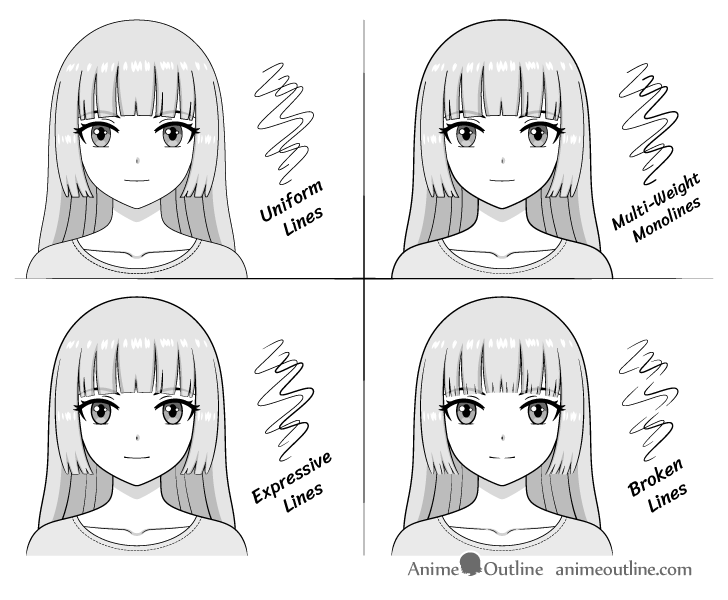
Anime, manga, and comic books are generally done with black outlines, making linework very important to these storytelling mediums. If you like drawing in such styles or simply drawing in general, this guide can provide you with some very helpful insights into how you can make your art appear more fluid and organic, simulate light and shadow, and create a sense of depth—all with just lines.
Uniform Line Weight
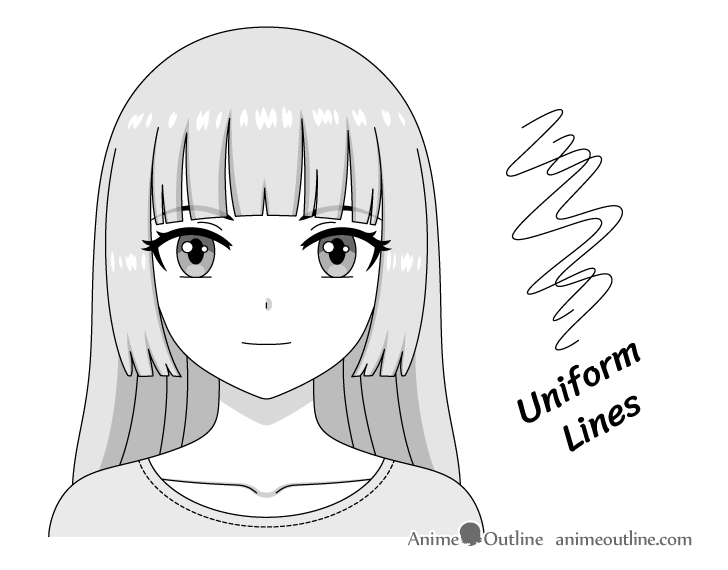
Description: Uniform lines have even thickness throughout their entire length.
Examples: Uniform lines are used in anime shows as drawing multiple frames of animation with varying line weight is difficult and time-consuming.
Use: You can make uniform lines by applying even pressure to a pencil as you draw. Generally, this is a fairly natural thing to do, especially for beginners.
Multi-Weight Monolines
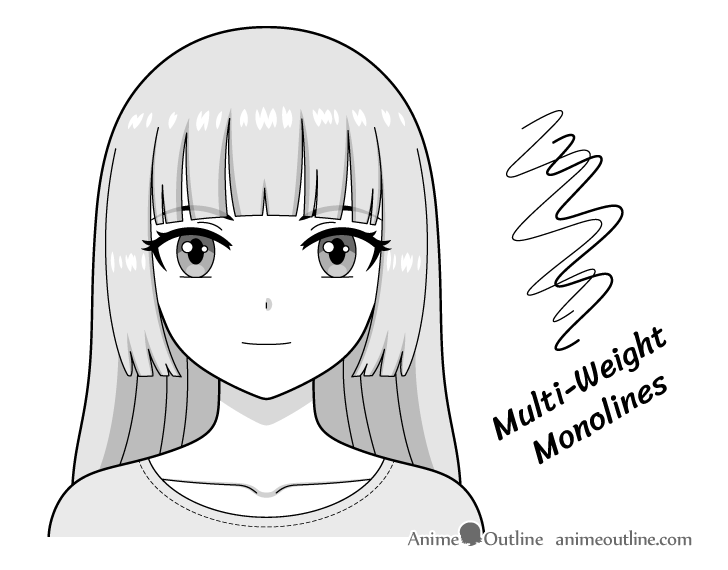
Description: Multi-weight monolines are sets of lines that vary in thickness in relation to one another. However, each line is still of even width throughout its own length.
Examples: Multi-weight monolines are primarily used in illustrations, especially in digital and vector art. You may see multi-weight monolines in some more stylized anime scenes, particularly ones with chibi characters. You can also often find them used in the art on various anime merchandise such as stickers or pins.
Use: You can create multi-weight monolines by giving parts of a drawing thicker outlines. This is doable by either consistently applying more pressure to a pencil or by using a black marker.
Modulated/Expressive Line Weight
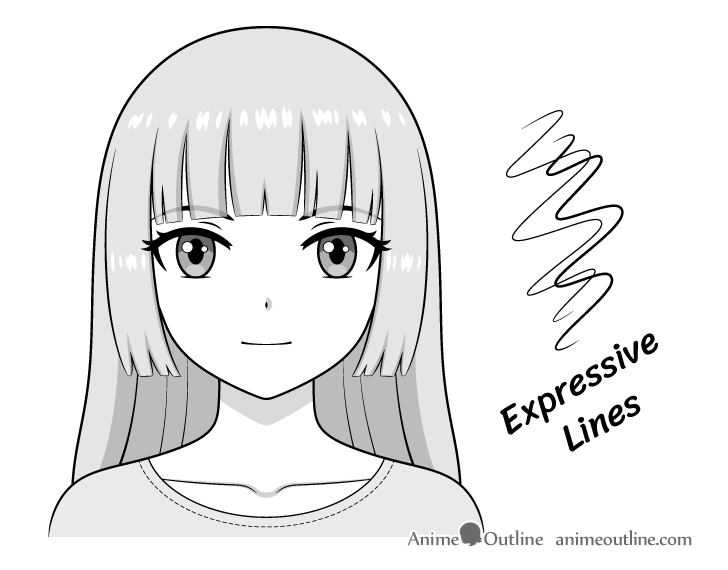
Description: Modulated or expressive line weight is when lines vary in thickness along their own path. These are very common in manga where lines not only vary in thickness in relation to one another but also internally.
Examples: Modulated line weight is very common in manga. It can be seen on drawings of hair where the lines taper off towards the tips or on clothing folds where the lines get darker around their deeper recesses.
Use: You can create expressive lines by applying more or less pressure to a pencil. For really pointy tips you can quickly pull your hand away from the paper as you make the stroke.
For a list of drawing materials, including those suited to creating expressive lines, see:
Essential Anime & Manga Drawing Materials Guide
Broken Lines
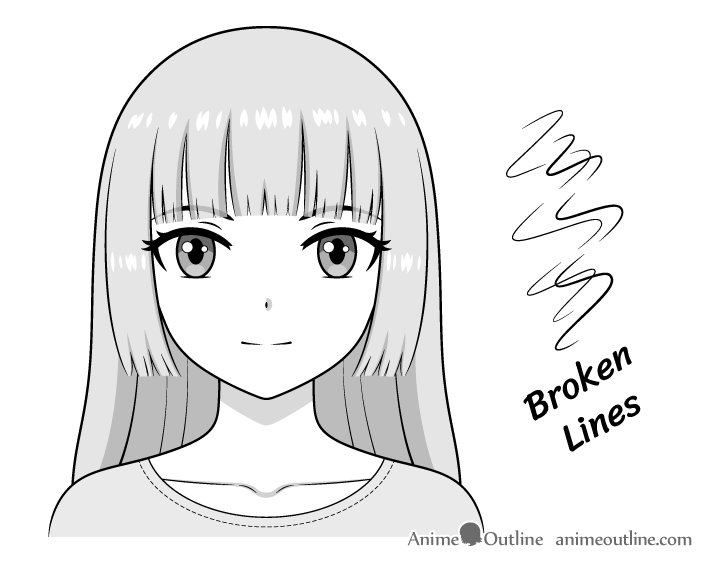
Description: Broken lines are a technique of using gaps in lines to create certain effects. This is often done to show light or give a sense of softness or dispersion. Leaving little gaps can also help a drawing appear more organic and less like a wireframe.
Examples: You can find broken lines used in anime, manga, and comic books to create soft-looking ends of hair bangs and to show light being caught by the corners of various objects.
Use: You can create broken lines by simply leaving gaps in your linework. However, if you want to make your drawings even nicer, you can also taper your lines around these gaps to create really fluid-looking artwork.
Spacial Lines
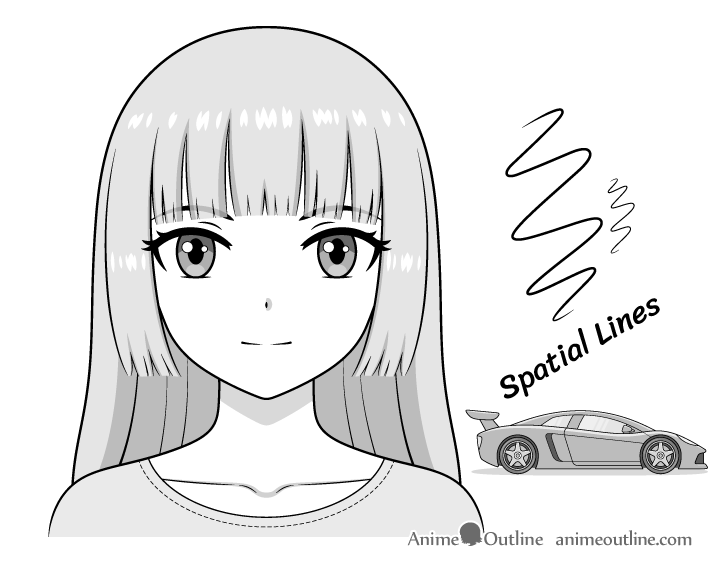
Description: Spatial lines are created when multi-weight monolines or expressive lines are used to convey depth. This is achieved by applying thicker overall lines to foreground characters or objects and thinner lines to those in the background. This can also apply to parts of a character or object.
Examples: Any manga scene where an up-close view of a character is drawn with thick lines while the objects in the background have thinner outlines.
Use: Combine line weight with perspective drawing by defining the objects closer to the viewer with darker lines and using progressively thinner lines on objects as they get farther away.
For a basic guide on perspective drawing, see:
Perspective Drawing Tutorial for Beginners and How it Relates to Anime
Line Quality
Another thing to be aware of when drawing is line quality. Try to make long, continuous strokes. Don’t create messy lines unless you are using them to get a special effect.
Generally, you want to avoid the following bad artistic practices:
- Chicken Scratches: Chicken scratches are created by the use of many tiny misaligned strokes to define a form or a path.
- Short-Stroking: Short-stroking occurs when artists create lines by making tiny dashes instead of long, continuous strokes.
- Over-Sketching: Over-sketching is the use of many, often imprecise lines to define a form, resulting in heavy scribble-like outlines.
For more on common drawing mistakes, see:
Common Mistakes When Drawing Anime & Manga
What Lines Should You Use?
- Uniform Lines: If you want to keep things simple and make your drawing similar to anime, go with fairly thin, uniform, solid lines.
- Expressive Lines: If you want to “go all out,” use expressive lines with gaps for special effects.
A lot of the tutorials here on AnimeOutline are done with varying line weight. However, most are put together in a way where you can use uniform lines if you prefer.
Line Drawing Exercises
If you wish to practice with simple line drawing exercises before getting into more complex artwork, you can find some near the end of the following tutorial:
Beginner Guide to Drawing Anime & Manga
Conclusion
If you are a fan of anime and manga and like to draw in such mediums, line weight is particularly important, as black outlines are one of the most defining features of these styles. This guide looks at the main linework variations. By correctly applying these, you can make your art more fluid and organic, convey a sense of light and shadow, and create an appearance of depth.
If you’ve found this tutorial helpful, you may also be interested in the following: